
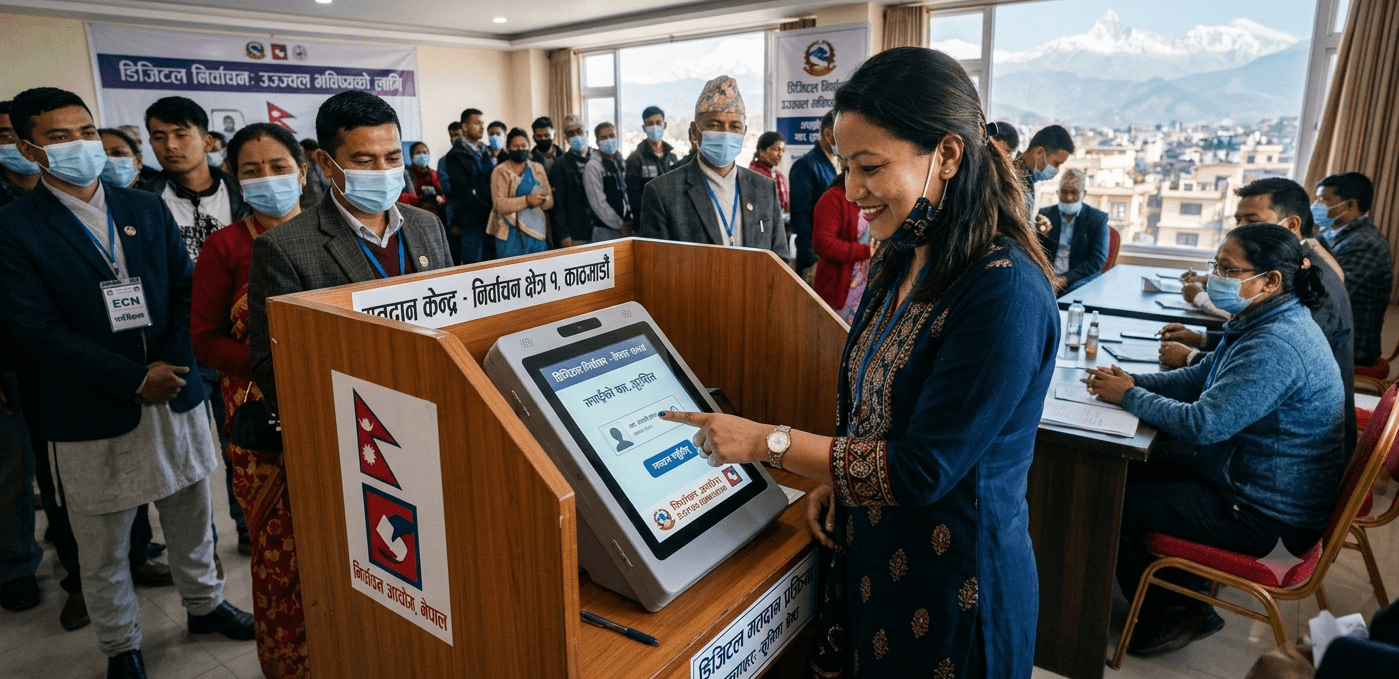
As Nepal continues its journey toward digital transformation, an important question is emerging: can technology make elections more accessible, efficient, and inclusive? While digital elections are often viewed as a natural step in modern governance, their implementation requires careful planning, strong institutions, and public trust.
Nepal’s electoral system has traditionally relied on paper ballots. This system has helped deliver credible and peaceful elections and remains widely trusted by voters. The country’s only significant experiment with electronic voting took place during the 2008 Constituent Assembly election, when Electronic Voting Machines (EVMs) were piloted in selected areas of Kathmandu. Although technically successful, the initiative was not expanded nationwide.
Today, however, Nepal faces new challenges that are prompting renewed discussions about digital elections. Large-scale labor migration, urbanization, and internal migration have weakened the connection between many citizens and their registered voting constituencies. Millions of Nepalis living abroad remain unable to participate in elections, raising concerns about democratic inclusion and representation. At the same time, increasing internet access, mobile connectivity, and digital literacy are transforming how citizens interact with public services.
A New Generation of Digital Citizens
Nepal’s electorate is becoming younger and more digitally connected. Many first-time voters regularly use online banking, e-commerce platforms, digital payment systems, and government services. For these citizens, long journeys to polling stations and manual election processes may appear outdated.
However, digital expectations must be balanced with realities on the ground. While urban youth often possess strong digital skills, many rural communities and migrant workers still face challenges related to internet access and digital literacy. Therefore, the goal should not be immediate internet voting but rather the gradual introduction of technology that improves accessibility and administrative efficiency without excluding vulnerable populations.
Nepal’s Digital Readiness
Nepal’s digital landscape has improved significantly in recent years. Mobile penetration exceeds the country’s population, internet use continues to grow, and broadband services have expanded across much of the nation. These developments provide a promising foundation for future digital election initiatives. The Election Commission of Nepal (ECN) has also made considerable progress in digitizing election administration. Integration with the National Identity database, digital candidate nomination platforms, and electronic result publication systems have improved efficiency and transparency. These achievements demonstrate that Nepal can successfully manage large-scale digital election infrastructure.
Nevertheless, readiness for digital administration does not automatically mean readiness for digital voting. Significant challenges remain, particularly in rural connectivity, power reliability, cybersecurity, and legal preparedness.
Digital administration does not automatically mean readiness for digital voting.
The Cybersecurity Challenge
Any discussion of digital elections must address cybersecurity. Election systems are attractive targets for cybercriminals, hostile actors, and disinformation campaigns. Risks include unauthorized access to voter databases, denial-of-service attacks, phishing campaigns, misinformation, and manipulation attempts.
The consequences of a successful cyberattack could be severe. Beyond technical disruptions, even the perception of insecurity can undermine public confidence in election results. This is why robust cybersecurity measures-including continuous monitoring, incident response capabilities, staff training, and collaboration with national security agencies-must be established before introducing voter-facing digital technologies.
Citizens themselves also face risks. Fake websites, fraudulent messages, and online disinformation can confuse voters and damage trust. Public awareness and digital literacy will therefore be just as important as technological safeguards.
Security
Resilience
Public Trust
Legal and Institutional Preparedness
Nepal has taken positive steps through the National Cyber Security Policy and existing election legislation, which provide a foundation for digital innovation. However, significant regulatory gaps remain. Detailed standards for technology certification, independent security audits, cybersecurity compliance, and accountability mechanisms are still underdeveloped. Without these safeguards, introducing electronic or online voting could create risks that outweigh the benefits. Strong legal frameworks must come before technological expansion.
Learning from Global Experience
International examples offer valuable lessons. Estonia is often cited as the global leader in internet voting, but its success is built on decades of investment in digital identity systems, cybersecurity infrastructure, and public trust. Other countries have taken a more cautious approach. Germany discontinued electronic voting due to transparency concerns, while countries such as the Netherlands and Ireland abandoned similar initiatives because of security and cost issues. These experiences show that technology alone cannot guarantee successful digital elections. Trust, transparency, and strong institutions are equally important.
Technology alone cannot guarantee successful digital elections. Trust, transparency, and strong institutions are equally important.
What Should Nepal Do Next?
Rather than pursuing rapid implementation of electronic or internet voting, Nepal should adopt a phased and evidence-based approach.
In the short term, the focus should be on improving participation without changing the voting method. Solutions such as cross-constituency voting for internally migrated citizens, stronger results transmission systems, and enhanced election transparency can address many existing challenges.
In the medium term, Nepal could pilot controlled voting options for overseas citizens through embassies and designated voting centers. Such pilots should be carefully monitored, independently audited, and supported by strong cybersecurity safeguards.
Only in the long term, after demonstrating sufficient institutional maturity, legal readiness, cybersecurity capability, and public confidence, should Nepal consider expanding voter-facing digital voting options. Even then, digital voting should initially operate alongside traditional paper ballots until reliability and trust are fully established.
Suggested Approach
Short Term
Improve participation and election administration.
Medium Term
Conduct controlled pilots and independent audits.
Long Term
Consider voter-facing digital voting when readiness is demonstrated.
Conclusion
Digital elections are not a quick fix for Nepal’s electoral challenges. They represent a long-term institutional transformation that requires careful planning, robust legal safeguards, advanced cybersecurity capabilities, and broad stakeholder trust. While technology can improve efficiency and accessibility, it cannot replace transparency, accountability, and public confidence. For now, Nepal’s most practical path is to strengthen the digital foundations of election administration while maintaining the trusted paper ballot system. Through gradual reforms, pilot programs, and inclusive stakeholder engagement, the country can modernize its electoral processes without compromising democratic integrity. Ultimately, the success of digital elections in Nepal will depend not on technology itself, but on the institutions, governance, and trust that support it.
Author
Yogesh Aryal
Election Technology • Cybersecurity • Artificial Intelligence • Digital Transformation